When Prime Contractors Demand CMMC Level 2: How to Respond
Understand the difference between CMMC Level 1 and Level 2, and learn how to manage unwarranted Level 2 compliance demands from prime contractors.
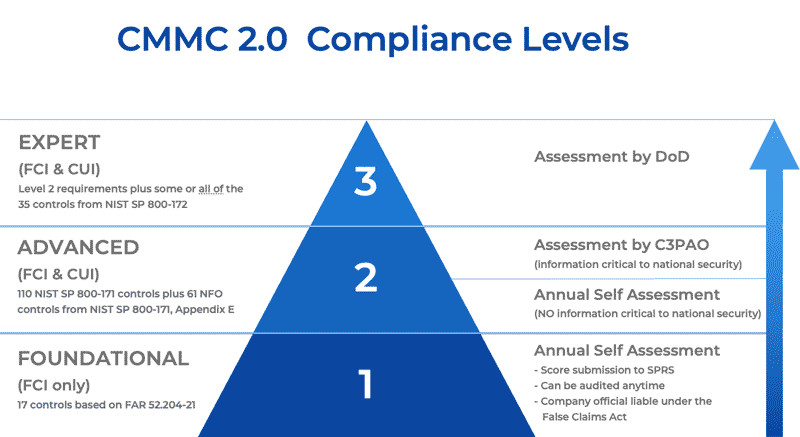
As the Cybersecurity Maturity Model Certification (CMMC) requirements roll out across the Defense Industrial Base (DIB), many small defense contractors are encountering an unexpected challenge: prime contractors pushing down CMMC Level 2 or Level 3 requirements to all of their subcontractors, even when it isn’t appropriate.
If your organization’s role is primarily administrative—managing contracts, budgets, timelines, and communications with contracting officers—you likely fall squarely into the CMMC Level 1 category.
Understanding the distinction and knowing how to respond can save your business from the significant, recurring costs of standing up a complex NIST 800-171 environment prematurely.
The Difference: Level 1 vs. Level 2
The key to determining your required CMMC level lies in the type of information you handle, not who you work for.
CMMC Level 1 applies to organizations that handle Federal Contract Information (FCI).
- Level 1 requires a self-assessment against 17 foundational cybersecurity controls.
- If your assets involve standard administrative and contracting workflows, Level 1 is likely your target.
CMMC Level 2 applies to organizations handling Controlled Unclassified Information (CUI)—such as specific technical drawings, engineering specs, or sensitive defense-related data requiring safeguarding under NIST SP 800-171.
- Level 2 requires compliance with 110 advanced cybersecurity controls.
- This is a much larger undertaking involving potentially significant costs for external vendor security products and services.
Note: If your employees operate exclusively on Government Furnished Equipment, those systems are generally outside your compliance scope entirely.
3 Approaches to Unwarranted Prime Demands
If a prime contractor pressures you to meet Level 2, here are three structured approaches you can take:
1. Request Specific CUI Identification
Ask the prime to explicitly identify what CUI you would be receiving or generating under the contract. If they cannot point to specific CUI categories or marking requirements, there is no solid basis for them to demand Level 2 compliance.
2. Clarify Your Role
Remind the prime contractor that your responsibilities are administrative, if applicable. If you handle contracts, budgets, and scheduling rather than technical deliverables or controlled data, you do not have a “need-to-know” for any CUI.
3. Point to the Contract Clause
Request that they review the contract’s DFARS 252.204-7021 clause and the associated CUI scope. The required CMMC level must match the type of information actually flowing down to you, rather than a blanket requirement applied broadly to every subcontractor.
The Bottom Line
You should never be paying for a Level 2 assessment if CUI never touches your systems.
If your organization does need to build the capacity for handling CUI in the future, we offer fractional CISO and IT Director services to guide you through the process cost-effectively. Whether you need an assessment against the Level 1 controls or a roadmap to Level 2 readiness, getting expert advice early on makes all the difference.
Contact us to discuss your specific CMMC situation and find out exactly what level of compliance your business operations require.